Welcome to the Official Class Blog of GRA217- Section 4

Sunday, February 28, 2010

Buchholz | Week Six


Design Strategy and client information: The non-profit organization I chose to promote is The Delta Gamma Foundation’s Service for Sight. Service for Sight was founded by Delta Gamma and is it’s national philanthropy. Being that I am a member of Delta Gamma Women’s Fraternity, I felt that creating a poster for our upcoming philanthropy event, Anchor Splash, would be the most reasonable idea. Anchor Splash is a day of pool games that college students in Greek life participate in. I wanted the poster to be eye-catching and at the same time, representative of Delta Gamma. The anchor is representative of Delta Gamma among Greek life and therefore lets viewers know who is organizing the event. The use of color was not a problem and I thought the deep blue and golden bronze colors complemented one another well. In designing this poster, I really wanted to represent Delta Gamma well, while briefly explaining the event in the tag line “making changes, one splash at a time.” My overall goal for this design was to create a simple and visual, yet memorable poster for Delta Gamma’s Anchor Splash philanthropy event.

Choice of typeface: The two typefaces I chose to use were Emmascript MVB Std and Antique Olive Std Regular. I really liked the Emmascript and thought that it would make a good headline font. Although script is sometimes difficult to read, I felt that is complimented the splashes coming off of the anchor. Since young audiences will be viewing this poster, I assumed that using a script font for the headline would be fairly clear to read, especially when used in a large size font. For the text of information about the event, I used Antique Olive Std Regular. I thought this was an easy sans-serif font to read and it reminded me of past emblems for Delta Gamma.

Visuals: To create the anchor design, I searched for a simple picture of an anchor on Google Images. I then placed the picture in Adobe Illustrator and traced the anchor using the pen tool. I made the outline of the anchor in black and the fill of the anchor bronze. For the waves, I used the hand drawn vector tool and used the brush tool to draw three waves. I then used the same hand drawn vector tool to create continuity among the water splashes and the waves. I brought the wave image to the front to make a small part of the bottom of the anchor seem as though it was under water and making a splash. I exported this image as a JPEG at 350 dpi and placed it in Adobe InDesign to complete my poster design. I think this image works really well for the poster because it embodies Delta Gamma. Delta Gamma’s symbol is the golden anchor and is recognizable to members in Greek life and also is a key word in the events title, Anchor Splash. The visual is essentially the title of the event.
Regarding color, I used too CYMK colors. For the anchor, I used a golden bronze color (C=36.86, Y=100, K=41.18, K=9.8). I thought this color was relevant for the design because Delta Gamma’s symbol is the golden anchor. For the waves and the splashes, I used a deep royal blue (C=100, Y=5, M=72, K=0). I used this blue because I thought this color complimented the bronze well.

Saturday, February 27, 2010

Week Six | Odiamar

GRA 217: Project Two – Poster Design

The not-for-profit organization I chose to create a poster for is The David Sheldrick Wildlife Trust that aims to “protect and preserve Africa’s wilderness and its denizens”. The event is to raise money and awareness for the orphaned elephants in the Sheldrick Trust, located in Kenya. The sold out event takes place in Soho, New York making the demographic for this poster people, in their late 20’s to early 40’s, of economic stability, who are knowledgeable about quality design. The parameters I set for myself were to create a simple, eye-catching design that uses minimal color, to conserve funds, and quickly delivers the general theme of the event.

I chose to use two different typefaces in this project. I wanted to use typefaces that would mix the structure and refinement of New York with more of a natural typeface representing the wildlife of Kenya. My first set or words as well as the information about the event were done in Optima. I chose this font because I feel it is a more refined sans serif; simple but elegant with flairs on certain letters. For the line “One Heart” I chose to use Handwriting – Dakota. As the name implies it looks as if it was handwritten giving it a more fluid almost wild feeling.

The visuals in my poster were all created with tools from Adobe Illustrator. The main focal point of the design is the elephant that I free hand drew with the Paint Brush Tool and a tapered stroke. The buildings were created with basic straight lines with the Line Segment Tool. Like the use of my two different fonts I used these two images to deliver the idea of two worlds intersecting. Both images are simple, but in different ways: The elephant is just a juxtaposition of lines but they are more organic and representative of the wilderness where as the buildings are ordered and even, just as a city truly is. I chose to use only two colors, the backdrop being a golden orange to relate to the vibrant nature of Kenya that contrasted with the wild flare of red in the text. Finally, I placed the organization’s logo in the upper right hand corner with a flourish of light coming from it as if to represent the sun shining down upon New York using the Flare Tool.

Week 6- Westbury

The non-profit Organization I chose is Kristen Alyce’s Garbage Gone Glam Fashion shows. This non-profit is centered on recycle awareness. The event focuses on giving consumers a new creative outlook on green alternatives. This specific event is targeting women. The featured designer is Sararose. Sararose is a very known icon in women’s fashion. With this information I designed my poster in a way that it would grab the eye of women. I wanted some type of diamond image on my poster with a black backdrop as well as the main title in Hot Pink. With the black background I knew that the hot pink and the Diamonds would stand out to any woman passing by this poster. Originally wanted the actual poster to be a trashcan. Due to the fact that I wanted the last word “Glam” to be in diamonds, the whole grey trashcan would not allow viewers to see the Diamond filled “Glam”. I wanted an all around poster that screamed femininity with a touch of Glam. My organization can afford color printing however not a huge surplus, therefore I wanted my poster to be direct and eye-catching, making to associate garbage with glam.

The typefaces I chose were very strategic. I wanted the “Garbage” word to be in Sans Serif and in a medium type. I wanted Garbage to be the largest word on the poster to emphasize the event. The word “gone” I wanted in Florens to go with the feeling that comes with gone. To be gone is to be swift, it is the action of leaving, it is to be absent. The typeface Florens leans to the right slightly, giving the allusion of movement. With this visual I felt like it went perfectly with the word "gone" in the title of the poster.

Friday, February 26, 2010

Week 6 Poster Project/ Darra Markland

** this is not the finished product. I accidentally forgot to open the original document as a tabloid so I have to fix the proportions/placement of the text and image

Design strategy:

I immediately knew that I wanted to design a poster for the Polar Bear Plunge, a not-for-profit event that annually occurs in Rehoboth Beach, DE (and in other states as well) to raise money for the Special Olympics. I decided to have an exiting image of a polar bear diving as my visual, and that I wanted my design to be as simple as possible while still conveying the importance of this event. This event is a family-fun day that attracts people of all ages, so I wanted the poster to be bright, friendly, and casual. I used colors from the Pantone Solid Matte collection under the "Beach" category. I incorporated a gradient effect to visualize the polar bear diving into water and to enhance the visual hierarchy of reading down the poster for information about the event.

Choice of typefaces

I used two very different fonts; a serif font called Marker Felt and a script font, Handwriting-Dakota. I liked the contrast this difference supplied to the simple poster. Also, they are both extremely casual and fun which I feel appeals to the audience I am aiming to attract. I played around with leading and kerning of typefaces, and surprised myself when I realized that I actually liked the way the headline looks without my changes. I like the space between the letters in PLUNGE (especially to allow room for the snowflake), and the imperfections between the letters in the script font emphasize the visual of handwriting I wanted to form. While I know adjustments in kerning and leading were a part of this project, I honestly felt this was the best solution for the overall intention of my poster design.

Visuals

The image of the polar bear is something that I knew I wanted to draw imperfectly. To me, this symbolized that the event is open to anyone (you don't have to be a trained swimmer to dive into the ocean and be part of this event!), and it also reflects the heartwarming aspect of this event, since it almost looks like a child illustrated this bear. The snowflake is also not perfectly drawn for this exact reason. I chose to bleed off of the page instead of setting margins to enhance the visual of water. The Special Olympics logo proved a difficult task to incorporate into the poster, as it did not easily allow me to create a transparent background. But I wanted to include it, and fixed it the best I could.

Week 6: Poster Project, Josh Schulman

Design Strategy and Client Information:

The Walk for Beauty, Walk for Life is a charity event that occurs in my hometown of Stony Brook, N.Y. The event is a fundraiser for breast and prostate cancer research that will use the money to conduct cancer research in the Stony Brook University Hospital. The demographic of the event is local area residents that include everyone from high school students to senior citizens. The event is organized by various groups and spends a lot of money on the event, which is why I used a lot of color that would attract people to the poster and then hopefully for the event. I wanted to emphasize the class, enthusiasm, and good will of the walk.

Choice of Typefaces:

I chose Dorcester Script MT STD for “my header,” or the title of the event. I saw this typeface, of the script race, as perfect for the event because it conveys a font of class but yet is easy to read. It has a medium x-height, which also adds to the readability and is similar to the typeface that the event actually uses for its brochure. The typeface is also in 150 pt. font, a large but not dominant size, and is in a pinkish color (C=0%, M=95%, Y=20%, K=0%). The leading is also at 140 pt.

The “footer” or information for the event is in the font Univers LTD STD 57 condensed. This is a sans serif and has a medium x-height. I chose this typeface because it is very easy to read and is difficult to just glance over. The topics of the information, such as “date,” time,” etc,” is in 50 pt font and the actual information is in 42 pt font. That whole section is in the same color as the header (C=0%, M=95%, Y=20%, K=0%) and has 65 pt. leading between each line.

The middle font, or the cause of the event, is in the road between two trees. This is in Univers LT STD as well. It is in size 42 pt font and has a 1 pt stroke so that it stand out from the road and trees surrounding it. It has 50 pt leading and is in the same color as the header and footer (C=0%, M=95%, Y=20%, K=0%).

Visuals:

I traced the trees and ribbon from images I found on the Internet. I then cut the ribbon using the knife tool and placed each half around the tree to make it appear as though the ribbon were wrapping around the tree. I chose to do this because I believe that a tree represents the idea of life and the ribbon obviously represents the fight against cancer. I though that the combination of the two would create a fighting yet classy image that would be beneficial to the walk. The green head of the tree is in Pantone Hexachrome Green, the trunk of the tree is in Pantone 1545C and the pink ribbon is in Pantone 813C. The road, which represented more of the journey of the fight against cancer, is in a lighter black (C=0%, M=0%, Y=0%, K=88%).

The gradient of the entire poster is linear and has an opacity of 0% and has a location of 86.61% between the scale of the blue and green. I added the gradient to seem like the green ground and blue sky, which adds more life to the poster.

Del Castillo | Week 6


This poster was designed for my church back home for an annual dinner dance they have. The demographic is very broad, spreading from teens to senior citizens so I wanted the design to be something that was not directed at just one demographic. They usually do print in color so using color is not an issue when designing for them. I wanted it to be light and happy and make people want to come spend the night dancing and hanging out with friends. I thought combining familiar elements of disco with snow to represent the season would be playful and appeal across a wide range of ages.
I chose papyrus for the first font because it is a very old type and when you think of the Bible you think of something old. I put the last two words in Ozwald because it gave it a "groovy" feel and I wanted to convey a feeling of excitement. For the information about the event I used Gill sans because it is very generic and easy to read, ensuring that the important information is not misread.
For the visual, I traced the outline of Disco Stu from the Simpsons and the copy pasted and reflected the second image. I wanted to go with the disco theme so I was considering something from Saturday Night Fever but I found this picture and liked the way it looked better. Once I traced the picture I filled it in to create a black silhouette.

Wednesday, February 24, 2010

Week 6 - Blackstone


Designed for the Jimmy V Foundation, this posters demographic is for supporters of cancer research but more specifically, for golfers. I chose a multi-colored pallet because the Jimmy V Foundation has the capital to print this kind of poster. The design is a tracing of a notoriously hard hole, the 17th at TPC Sawgrass. Since this poster is aimed at golfers and this is a famous hole in golf, their knowledge of the hole is assumed but not needed to convey the intended message. I chose this design because I wanted to connect the difficulty of curing cancer with the difficulty of this hole in particular.
The typeface I chose for the title “Jimmy V Celebrity Golf Classic” is ITC Zapf Chancery Std Bold. I chose this type because I liked the way this typeface used the letters ‘V”, ‘F’, ‘Y’. I also used the envelope option to make the type have a wavy effect since it is positioned in the water.
The typeface for the body text is Optima Ltd Medium because of its clarity and great kerning even in a large point. It is an unadorned typeface but I was looking for a more to the point message so I felt this typeface worked. There isn’t any real age group that dominates my demographic audience so that didn’t have too much of an effect on which typeface I chose.
I created the visual by tracing a picture of the hole that I found on the Internet. I started by tracing the island then traced the water, the grass, and the buildings. I finished by adding things like trees, bushes, and birds with the pen tool and paintbrush applications. I used the CMYK color scheme for the poster, using a variety of different shades of green for the grass and the island green. I also used a few different shades of blue, one for the water, one for the sky, one for the windows, and one for the buildings roof.

Week Six-Walsh

Design Strategy and client information:

My client, Earth Day Networks, is trying to reach out to a demographic of mainly middle age and younger people, as they are the most active age groups. They are trying to reach both men and women and attract them to taking up the cause.

Due to the size and prominence of Earth Day Networks, proper funds are not an issue. Therefore, they are able to afford color printing without a problem.

In this project I was trying to create a design that conveyed a serious overall message in a casual manner. By doing so I am hoping to provoke people to act out of interest in helping the Earth, and not as a result of guilt. As a result I decided to go with something fairly amusing. The message is serious but it is presented in a fairly comical way.

Choice of typeface:

I decided to use the VAG Rounded Standard typeface on my poster. I felt that a sans serif font, such as VAG Rounded Standard, would work best on a poster with the casual message and visual effects such as mine. The main headline is in VAG Rounded Standard Bold, and the rest of the message is in VAG Rounded Standard Thin.

The first letter of every word is capitalized, but I felt that capitalizing every letter would come across as too bold. I felt that the message would best be captured with the less bold look.

The message on the poster is short, and therefore there was no reason not to make the font very large and very readable. The look of the font is modern, which bodes well for attracting a younger audience, but it still remains readable for any age group.

Visuals:

In designing Mars I started by creating an ellipse. After adding the red-orange color I used the texture special effect of craquelure, and artistic special effects of sponge and colored pencil. I designed Earth by taking a picture of the planet and live tracing it.

Monday, February 22, 2010

WEEK 5-westbury

Coca-Cola.jpg

This ad is a great example of the Gestalt principle of similarity. Santa is of course dawned in red and white from head to toe, which are the two colors that are always are attributed to santa. Coca Cola used this to their advantage because the red and white that santa is always wearing can also be attributed to the coca cola logo. In this ad Santa's elbow is directing the eye of the reader to the coca cola logo. With the black background it allows the reader to connect the red and white on santa, to the red and white in the coca-cola logo. This is a great use of color and association. With this famous ad, many viewers are able to connect the special feeling of christmas to the special feeling coca-cola gives to its consumers.

Sunday, February 21, 2010

Week Five | Toney


This "Got Milk" ad featuring tennis player Andy Roddick uses gestalt to carry the reader through the image. Roddick's all white tennis uniform gives way to the white tennis net. The net leads to eye to the text of the ad, which is the same color, and hence, equally as readable. "Got Milk" ads traditionally work this way: we notice what celebrity has the famous milk mustache, then read what the ad has to say. In this case, our eyes recognize Roddick before we follow the common color to the Got Milk? slogan.

Friday, February 19, 2010

Photojournalism Seminar/ Darra Markland

Since I am a photojournalism major, I attended the photojournalism seminar today featuring Ted Kennedy and a recent Newhouse graduate, and I'd like to share some of what I experienced. I was incredibly intrigued by Mr. Kennedy's presentation because he has accomplished so much. My dream has always been to work for National Geographic one day, which is the main reason why I pursued the Newhouse School. He was previously Director of Photography for National Geographic for 12 years, during which time he was involved in epic photography such as photographing the remains of the Titanic at the bottom of the ocean. After National Geographic, he shifted his work to focus on the rapid transformation into digital media (it was so interesting to hear about his photography days before going digital!) One thing in particular that he discussed which I felt related to our graphic design course was the constant improvements being made to his company's website over the years. He showed what it looked like over a decade ago as compared to now, and it is interesting how much greater their attention to detail in regards to color, organization, and typography have increased over the years. He also talked about how exciting it was to produce a website with scroll over icons that could change color for navigation, which displays the principles of hierarchy that we have studied. It's amazing how much more sophisticated and legitimate a website can look with the utilization of graphic design techniques. There were much more interesting topics and photography adventures covered throughout the seminar, but this reminded me the most of what we are studying in class.

Week 5/ Darra Markland

This business card is not only incredibly clever, but it exemplifies utilization of the gestalt principle. It is a graphic design for a radio station, and the information is given in a way that forms a turntable and volume controls. While at first the title of the radio station, "The Pleasure Principle" might be a bit difficult to read, it is a truly effective placement of letters to form the visual. The image and the information that the talk show hosts are trying to relay to their listeners compliment each other beautifully in this creative design. The angle of the radio station in the middle of the record point the reader's eye down to the rest of the information. Then, the vertical lines on the right sight of the "volume controls" draw the eye to the names of the talk show hosts. Overall, I am incredibly impressed with this graphic design.

Week 5 Spivack

The WWF logo is a great example of the execution of the gestalt principles. I causes the eye to continue the lines to form the image of a panda bear. The black-filled "blobs" are drawn and placed in such a way that the picture seems complete. The illustration is meticulously done in order to trick the eye into seeing a complete picture. The parts, if separated, would resemble nothing. The gestalt principle of continuation is demonstrated in this iconic logo.

Finding Gestalt: Coke Plus

This ad for Diet Coke Plus is an excellent example of an advertisement using gestalt principles. The ad is very simple. It just shows the product 4 times. But the designer creatively put them together, making a plus sign in the middle. This definitely gets the Diet Coke Plus name across. Also, on the bottom of the advertisement, it says "positive thinking, positive drinking". The fact that it's grouped together in a plus sign highlights the benefits of drinking this product. I also really like where and how the designer placed the coke bottles. The blue line under the word mark kind of sets up a nice visual.

Odiamar | Week Five

6.jpgIn this advertisement for DKNY's fragrance for women, Be Delicious, the image draws the viewer by applying well thought out gestalt principles. These principles of symmetry, similarity and proximity not only serve to create a clean and organized advertisement but also effectively draw the viewers attention to the product, the perfume bottle well disguised as an apple. The principles of similarity and proximity are very important in this advertisement as the image is divided between groupings of red apples to the left and green to the right. Symmetry is essential in making this a successful image. The woman in the center clearly and evenly divides the two sides and leads the viewers eye to the bottom of the page where the inconspicuous perfume bottle slightly stands out among the other apples. It is also intelligently placed between the BE DELICIOUS (the name of the perfume) and DKNY ( the designer). Overall this image does a great job of presenting a well organized well structured and interesting image.

Buchholz | Week Five


I think that this advertisement for Olay Total Effects does a great job using gestalt principles. Alone, the elements of the advertising would be meaningless, but when put all together, they create an aesthetically pleasing visual. The image with the at the left is a larger, cross-sectioned version of the actual product shown on the right. The advertisement does a good job of catching the viewers eye and does a good job with grouping the information simply in order to get the message across. The images really convey the message well as to what the product does. I think that it also has good linkage elements, as the curved line leads you across the page to obtain all of the information. The advertisement has good entry points as well. The information starts at the top left corner and leads you down to the product at the bottom right. Overall, I think this advertisement does a fairly good job and displaying gestalt principles.

Week Five-Walsh

This picture uses gestalt principles quite effectively. By positioning the title in big bold letters at the top left and lead down into the rest of the poster. It also appears that the designer of this poster used the Rule of Thirds, and utilized the Golden Mean Points. By positioning the title and the graphic on the Golden Mean Points they are much more effective in drawing the reader in. The graphic also assists in the gestalt. The ears of the rabbit point to the other side of the poster and leads the reader's eyes down the names of the authors.

Thursday, February 18, 2010

Week Five Blackstone


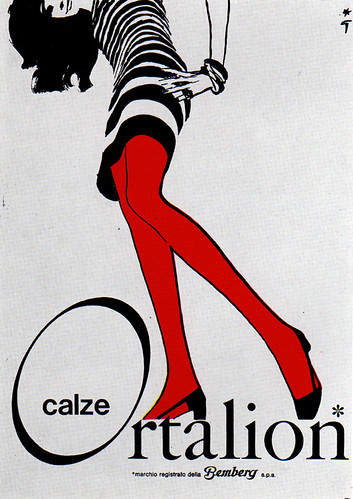
This poster from the 1960s uses gestalt principles in a variety of ways. One way is the idea of continuance. The eye is drawn towards the leg because of its color and positioning. From this the idea of movement with feet positioned at an angle causes the eye to draw down the leg, towards the feet, and thus right to the company name. Another gestalt principle is the idea of proximity, with the feet in close proximity to the company name and the "calze" in close proximity (inside the O) to the other part of the company name (Ortalion). The last principle is the idea of closure. At the bottom of the poster is the company name along with other important information. This puts these names in the observers mind last and also acts to group the writing together, causing as little interference with the visual as possible.

Week 5 | Del Castillo

I think this image is a good example of Gestalt because it is simple, balance and straight to the point. The pictures flow from the top left, across and down to the ring on the bottom. The only words are the name of the designer and the pictures of the rings are left to speak for themselves. The top tow images are also arranged so they are on the thirds, not right in the center, which gives the image an overall balance to the eye.

Wednesday, February 17, 2010

Week 5: Finding Gestalt --Josh Schulman


This poster for Edible Arrangements uses multiple gestalt visual principles. The main concept for this poster is visual, as Edible Arrangements wants to convince potential customers that their product is visually pleasing while stile edible. Therefore, Edible Arrangements used the visual of flowers, a universally pleasing visual icon, as the basis for one of its fruit arrangements. This uses the gestalt principle of uniform connectedness for the fruit, as flowers are connected. It also uses the principle of closure, as people look at the arrangement and are supposed to immediately think of flowers and associate that with the edible fruit. Finally, Edible Arrangements uses the gestalt principle of proximity, also as flowers are, to connect the ideas of flowers and edible arrangements.

Sunday, February 14, 2010

Week Four | Toney


Design Strategy:

Creating a resume for my dream internship, an on-air host at ESPN radio, wasn’t the easiest starting project. As a freshman that is just beginning to get involved with on-campus activities, I was limited in my applicable experience. I was also unable to use more than two typeface options, yet I feel that the design of the resume caters to this goal.

By the end of the semester, I’ll be well versed in our course’s Adobe programs, plus LexisNexis and Windows Media Encoder, an audio editing program that, along with Garage Band, is phasing Audacity out in major radio stations. This factor would hopefully give me an edge over other applicants with more relevant work experience, but less applicable skills. Dropping the Newhouse name doesn’t hurt my chances as well.

Typeface Choice:

At first, I chose News Gothic as my Wordmark font because of the name; after all, the media deals with news, right? Then I realized that it had all the characteristics I was looking for in a font. It’s clean, simple, and modern, the latter of which is a trait I try to suggest I am throughout my resume experiences. To add some “eye-catching” ability, I used red to highlight the bullets in my name. Staying consistent with gestalt principles, I used the same News Gothic font in my resume headlines, this time in red to highlight each section. Different variations of Bell Centennial font complimented News Gothic well, while maintaining the modern look that sans serifs so easily provide.

Saturday, February 13, 2010

Week 4 Project Posting/Markland

resume-image367418.jpg


Design Strategy:

For my resume, I first decided that I wanted to take advantage of our option to utilize color. While this can be risky in the professional world, I tried to use soft colors that would portray my personality but that would also be appropriate for my audience. As a photojournalism major, my intended audience would most likely be another photographer or an editor of a social medium (such as a magazine, newspaper, or advertisement agency). I used two different shades of green for my wordmark; a light sage green and a darker evergreen color. I liked these colors because I think they give off a relaxed and natural feeling. As a photographer, I love to shoot landscapes so I felt this was appropriate. I also liked that it was not too bold because I am a laid back person, so hopefully my combination of greens and light gray portray this aspect of my personality on paper.

It took me a while to decide on the format of my resume. Originally, I wanted my name to be vertically written sideways on the right side of the page, bordering my body text. However, as I played around with different creative ways to write my name, I realized that the two letters “a” and “r” occur in the same place in my first and last names. I wanted to take advantage of this so it led me to placing my word-mark at the top of the page. I also wanted to group my experience, education, and skills in one section while organizing my extracurricular activities in a separate section. I placed my experience and education directly under my name and in a larger text box since they are the most important. However, looking at my resume now, I’m concerned that highlighting my extracurricular box in gray may have back-fired and may cause the reader to look at that information first. I may have to consider this when I revisit the resume.

Typefaces:

My laid-back personality explains the type-faces I chose. For the body text, I wrote in Cronos Pro Caption, a Humanist Sans Serif. Without the flowery serifs on the letters, this font has a casual feel. For my word-mark and headers I used ITC Leawood Std Book. I liked it because it is also casual but adds a feminine flare to my resume with the serifs on the ends of each letter. To decipher the letters of my overlapping first and last names, I used standard ITC Leawood Std Book for all of the letters of my first name, and used ITC Leawood Std Book Italic for my last name. But the overlapping “a” and “r” are in the same evergreen as my last name. This way these two letters are the same font as my first name but same color as my last name to tie it all together.

Friday, February 12, 2010

Week Four-Phalen

Design Strategy:

My objective for my resume was to create a simple and classic design, but still have it stand out to a potential future employer. I prefer to have my accomplishments and me as a person impress my audience, not the special colors or fancy design. My overall goal was to come off as professional, down to earth, and traditional.

Typefaces:

In order to achieve my goal, I chose typefaces I thought appeared sensible and timeless. Even though I wanted to portray these ideas, I also wanted a typeface with a little something special. This is why I chose ITC Fenice Std and Optima. ITC Fenice Std is a serif typeface with a very tall x-height. Typically I don’t like fonts with high x-heights, but Fenice really stood out to me. It seemed to have the feel of a traditional font of the eighteenth century, but with a more modern twist. This is why my watermark is in this font, because it exemplifies exactly how I would like to be perceived. My body typeface is Optima, which is a sans serif font that also has a very large x-height. This helped me to connect the two fonts. Optima is also very easy to read, so my audience wouldn’t need to strain themselves to read it. Although it is a more modern font, it isn’t futuristic. It shows that I have knowledge of modern technologies and ideas. These two typefaces perfectly portray me and help reach my goal of a professional and traditional attitude in my resume.

Jessica Choi Resume

Layout Design Strategy
I decided that my resume would stand out more if my name was located on the right. Not only is it a bit different, but it saved a lot of room for the body of the resume. I created a thin black border on the left and right side of my body's text box. The black borders made the resume look a lot cleaner as opposed to just the tick red border on the right side. It outlines and draws more attention to the resume.

There are three main colors on my resume: red, white, and black. my first and last name is written in white because it is clean and noticeable. My middle initial is written in black because I wanted it to separate and frame my first and last name. I chose red as the background color because it always looks bold and modern. Furthermore, it's unbiased to gender it can be either feminine or masculine (I wanted my resume to be neutral). My word mark may look simple, but the color combinations and slight alterations create a unique and fresh look.
Typeface Design Strategy

I used two typefaces for this resume: Gill Sans and Apple LiGothic. Legibility and order was my main concern when it came to choosing fonts. I had a lot of information that I wanted to put on my resume, so I was worried about it looking cramped and cluttered. So I chose two fonts with sans-serif typefaces with medium x-heights.

My word mark is written in the famous Gill Sans font. From class, I know that the Gill Sans font is classified as a humanist sans0serif typeface. I used this typeface because of their well-known reputation of having a modern and clean look. I used all capital letters to highlight the modernity, strength and stability of my whole name (middle initial included).

The body of my text is written in the Apple LiGothic font. I noticed that this font had a really small type-size compared to others, so I increased the size of he font in order to make it more legible. Although the type-size is small, Apple LiGothic maintains the same modernity and legibility as the Gill Sans font.

Week Three-Walsh


This ad for Kenwood Chef is very effective hierarchically. The text, modern looking, easy to read sans serif, leads into a picture, which then leads the reader's eyes down to the company's name. The point of entry on the ad is the text, a humorous comment that attracts the reader. It then leads into the picture of the happy couple with their Kenwood Chef, and ends with the memorable Kenwood Chef wordmark. By reading the wordmark of the company last, the company name is best remembered, which is the point of the ad.

Week Four-Walsh


Design Strategy:

My intent was to design a resume that would help me to obtain a job at a large public relations firm. Thus the goal of my design was to create a resume that would be capable of standing out in a large pile of other resumes; however, my aim was to create a design that would stand out because of its strength and message, and not because of flashiness or flamboyancy.

I created the design of headers alternating down the page to give the resume unique character. A straight read down the page would tend to cause ennui for the reader, which should certainly be avoided. My wordmark is meant to attract the reader’s eye, but in a very humble manner. It was designed to exude a serious yet prominent demeanor that would assert itself in the reader’s mind in a positive light.

Choice of Typefaces:

The wordmark and headers were designed using Charlemagne Standard Bold in a form of standing head, creating a visual gestalt. Charlemagne Standard Bold is an Oldstyle font that employs serifs. It is a very readable font of all capital letters that appears very business-like and serious.

Gill Sans was used for the sub headers and the body text. It is a very readable Sans Serif, with capital and lowercase letters, which conveys casualness and modernity. The combination of the Oldstyle and Sans Serif is meant to show that I am serious, but not uptight.

Extra:

I used special resume paper for my resume project to show that I take the appearance of my final design seriously. It improves the overall appearance by giving the resume a more firm and professional look.

Josh Schulman Week 4: Resume Project and Rationale


Design Strategy

The resume project was somewhat of a new experience for me. I had never created a resume before, which put me behind a majority of my peers, and therefore was behind both on content and on the concept of a resume. In addition to that, Adobe InDesign was a program that I had never used before as well. This made starting this project particularly overwhelming. However, the sample resumes I saw in lecture as well as the lessons I learned in lab were extremely helpful in helping me formulate a concept for the resume and the tools to execute on my ideas.

I knew of a few characteristics that I wanted my resume to have. First, I wanted it to be very simple. I did not want a resume with intricate and crazy designs that could confuse or inundate prospective employers for future internships or jobs. Also, I wanted it to be organized and very easy to read so that prospective employers could read it quickly and efficiently. Finally, I wanted my resume to be one that is representative of me, which I believe this resume is.

Choice of Typefaces

I decided to use two different typefaces for contrast: a serif and a sans serif.

The serif, Palatino, was an old-style serif. I chose that font for my body text because I believe that it is one that projects a sense of class and readability in larger proportions, such as the resume’s body text. Palatino also had a medium-sized x-height, which I found attractive as well. I used the regular subset of the font for the majority of the text, but I bolded my job titles in the “experience” section of the resume. The entire body text in Palatino font was 10 pt. and all of the numbers and some of the letters were kerned.

The sans serif I used was titled, “Univers LT STD,” a grotesque sans serif. I chose this font because it was very modern-looking yet quite simple and easy to read. It too had a medium x-height and was creative as well. The wordmark is in this font, sized 48 and kerned. The wordmark is also aligned in the center to create the connection of the “J” and “S” in my name. Also, the section titles are in this font, though in the subset “55 Roman” as well and is relatively heavily kerned. The color schemes of the wordmark and contact info are C=18 M=100 Y=100 K=10 for the red and C=96 M=86 Y=1 K=0 for the blue color.

Week Four | Odiamar

In approaching the design problem of creating my own, unique resume my intention was to create a design that would be simple and clean but also interesting with certain variations to the text to make it stand out. My first choice was in creating my word mark. I chose a design that plays off of the counters of the D and the O. I thought it was engaging to have the D and the O italicized with their curves interlinked creating an illusion of movement and creating a focus point for my audience. Thus, I purposely created my wordmark rather large so as to strike the reader immediately. I also chose to keep my entire resume in black and white with some variations of grays in certain places to make it look classic, clean and professional

In arranging my design space I tried to maintain a traditional page setup with the main body paragraph aligned to the left but made variations by aligning my wordmark to the left and making all the margins different sizes particularly the right one compared to the left and the bottom compared to the top, the earlier in both being larger than the later. I also knew that given this large space I had not very much experience to fill it with. Therefore I made the text size larger than usual and altered the leading between each line somewhere between fifteen to thirty six. The body part is lower than my wordmark and the other two texts boxes are well spaced away from the body avoiding clutter and confusion.

Choice of Typefaces

Keeping my intended audience of magazine companies in mind the typeface Didot reminded me of the fonts used by magazines such as Vogue and Elle. Also the variation between thick and thin strokes, particularly in the capitalized letters, struck me as very artistic. I felt that having all capitalized letters for my wordmark and headers in Didot would make it stand out and create uniformity. Also, having the first letter in some way very from the rest of the word would create an intrigue to how each slightly varies. For my body text I knew I wanted to use a Sans Serif and Franklin Gothic appeared to have thinner strokes that were very geometric and eye catching. Though, in general, Franklin Gothic would not be considered a good choice for body font I feel that since I made the text size slightly larger the type comes of very clear and pronounced.


In creating a design for my wordmark and for my resume as a whole, I tried to add a little creative flair while also keeping it very professional. My wordmark incorporated a large ‘L’ that connected my first name with my last name. I gave the large ‘L’ a light blue color to attract the eye and make it distinct from the other letters. I chose to make the other letters a light grey because I thought the mix of a light blue and a light grey worked well together and created the distinct separation that I wanted.

When designing the body of my text, my main goal was to create a strong hierarchy that was very easy to read and understand. My headers were set to the left and I chose the same light grey color scheme as in my workmark to make it distinct from the rest of the body text. In a side note, after I was 95% done with the project, I was informed that we weren’t limited to three textboxes so that is the reason for my lack of textboxes in the design.

For the typefaces, I chose Menlo for my workmark because of the unique shape of the ‘L.’ I wanted the ‘L’ to extend down and under my last name and this typefaces ‘L’ did just that. For the body text, I chose Gill Sans Light because it is a very readable, clear font and contrasts well with the bolder, thicker Menlo headers. All of my fonts are lowercase with low to medium x-heights which I preferred because of its readability.

Overall, I think this resume conveys a little flair of creativity but stays very professional and not over adorned which is the look I was going for. I also tried to have a strong hierarchical structure because it makes the resume very easy to read and understand. My audience is the magazine industry and the political science field so I tried to have some creativity in my word mark to appeal to the magazine people but maintain a strong hierarchy and professionalism for the political science people. Overall, this says that I am a creative person when I want to be but that overall, I'm all business.


In creating a design for my wordmark and for my resume as a whole, I tried to add a little creative flair while also keeping it very professional. My wordmark incorporated a large ‘L’ that connected my first name with my last name. I gave the large ‘L’ a light blue color to attract the eye and make it distinct from the other letters. I chose to make the other letters a light grey because I thought the mix of a light blue and a light grey worked well together and created the distinct separation that I wanted.

When designing the body of my text, my main goal was to create a strong hierarchy that was very easy to read and understand. My headers were set to the left and I chose the same light grey color scheme as in my workmark to make it distinct from the rest of the body text. In a side note, after I was 95% done with the project, I was informed that we weren’t limited to three textboxes so that is the reason for my lack of textboxes in the design.

For the typefaces, I chose Menlo for my workmark because of the unique shape of the ‘L.’ I wanted the ‘L’ to extend down and under my last name and this typefaces ‘L’ did just that. For the body text, I chose Gill Sans Light because it is a very readable, clear font and contrasts well with the bolder, thicker Menlo headers. All of my fonts are lowercase with low to medium x-heights which I preferred because of its readability.

Overall, I think this resume conveys a little flair of creativity but stays very professional and not over adorned which is the look I was going for. I also tried to have a strong hierarchical structure because it makes the resume very easy to read and understand. My audience is the magazine industry and the political science field so I tried to have some creativity in my word mark to appeal to the magazine people but maintain a strong hierarchy and professionalism for the political science people. Overall, this says that I am a creative person when I want to be but that overall, I'm all business.


Week 4 - Spivack


It was very difficult to produce a piece of paper that represented me. The font that I used for the wordmark, Jimbo, is very fun and has character. I believe that the playfulness of this font shows my personality as being silly. The more traditional Avenir typeface family that I used for the body text counters the outlandishness of my wordmark. Avenir is a very readable font and has a lot of variations. Putting the wordmark on the side of the page made it possible to include more content within the resume. The color red that I used, gives my resume some "pop" and also guides the reader's eye down the page. I made the headers within the body text Jimbo, and the first letter red to incorporate some consistancy and to tie my resume together. I made my resume fun but also professional because my audience, advertising professionals, want a resume that stands out but is not gaudy. I believe that my variaton of traditional and modern resume aspects combine to make a piece of paper that describes me as a person pretty accurately.

Buchholz | Week Four


Design Strategy:

When coming up with the design for my resume, I knew that I wanted it to look clean, fresh, and yet fun. I am advertising major and in order to catch an agency’s attention, I thought it would be a good idea to use color. I chose a navy blue and a deep lime green because I thought it described me. The navy is very simple and basic while the deep lime green adds a bit of flare. My word mark is centered at the top of the page and is simple and clean. I followed the same style for my headings as I did in my word mark. I think this provides fluidity throughout my resume. My headings and body are all flush left and each bullet point follows the format of my word mark and headings.

I think that my resume is clean cut, but also has a creative flare. This is important because in the advertising business you must be organized, but nimble minded. I think that my resume shows that I am organized and that I prefer continuity, but at the same time shows a creative side of me.

I chose to use Corona LT Std as my word mark font and use it in all lowercase letters. I used all lower case letters because I felt that it was fitting for me and stood out, but was not to bold. My headings are also Corona LT Std, to provide continuity throughout my resume. My contact information and body text are all in Caxton Std Light. I thought this was a fitting font because it is a serif font that is fairly easy to read, as it does not have too small or too large of an x-height. Although it does not provide contrast, I think it flows well with the font that I used for my word mark.

Thursday, February 11, 2010

Kochman Week 4


I wanted to make my resume something that would represent me. I chose to have the color blue within the resume since blue is my favorite color and is something that represents me. I chose to have my Education first for the time being because I believe that is something that is a little better than the Experiences so far. Once I get more experience in the photography field I plan to switch those two things around. I chose the font I did because I like how it looked and that is was a serif font. It is legable and works for my resume. I chose to have my name sideways because it would just take up to much space if it was on top. I also like how it looks when its on the side.

Del Castillo | Week 4


I wanted this resume to represent me and not someone else. I didn't want it to lie so I made it straight forward, even though it is not very impressive because that's who I am. I made the word mark and headers like I did so it would stand out a little but no obnoxiously. I also used the yellow box because it gives a nice contrast to the blue font. For the type faces, I used souvenir and avenir. I used avenir for the word mark and headers because it is very easy to read, and the capital letters and lower case ones work well together. I used souvenir for the body type because it is a serif font, although they are very subtle, and it flows nicely with the avenir font in the headers. Souvenir is a very easy font to read because it does not bunch up and has a slightly larger x height that normal.

Wednesday, February 10, 2010

TYPE CHALLENGE 2


Alright guys, here's the Valentine's Special type challenge. Look at the Godiva logo and email Professor Taylor the answer. The winner gets a free Starbucks card.

Sunday, February 7, 2010

TYPE CHALLENGE 1

Here's your first type challenge task:

1) Take a walk down to Marshall Street.
2) Stop at Augies.
3) Take a good look at their name board and tell us what the font is.
4)Email your answers directly to Professor Taylor.

The first correct answer will receive a Starbucks gift card. Well this should be fun...

Saturday, February 6, 2010

Week 3- Westbury

I looked at many websites, eventually making my way to the website for Bloomingdales. Looking at Bloomindales' website I really saw the concept of hierarchy of type that Lupton addresses. "Get the Skinny" is the first thing you see when you navigate to their website. It is the largest and brightest type on the page therefore this stresses to the viewer that this is a major feature that bloomingdales has for the season. Also when looking at the site, the Women's denim section is centered in the middle and is right under the quote "Get the Skinny." I believe this is because Bloomingdales knows that most of their clients are women therefore it is most important to them to emphasize the women's jean collection rather than the men's therefore addressing the concept of hierarchy. The men's jean section is to the right and in smaller type therefore illustrating that it is not as significant as the women's collection of jeans. Overall I believe that the website for Bloomingdales fully addresses the concept of graphics hierarchy.

http://www.bloomingdales.com/

Week 3/ Markland

I also looked for examples of Lupton's explanation of the strategic use of hierarchy. The website for BCBG, a high-end clothing line, makes great use of hierarchy to make their website easy to navigate. There is a separate section for each type of clothing, which drops down to a list of different subcategories. While the typeface itself is consistent throughout each category and subcategory, the subcategories are a smaller size font and are highlighted in an opposing color from everything else when the mouse is scrolled over them. Also, the images are extremely bright and contrast with the black/white typography of the different clothing lines, which adds to the organization of the site. One other thing I noticed is that the SALE section of the website is the only category that is written in red rather than white, which is a useful strategy because most consumers search for those good bargains when shopping.

http://www.bcbg.com/home/index.jsp

Friday, February 5, 2010

Jessica Choi and Quit Smoking Ad


In this anti-smoking ad, there are two things that really stick out to me.
This ad is an example of a good use of type. The font they used is clear, simple, and precise. Since it's an ad that can be seen both on and offline, the advertisers do not have that much text because the ad will only capture a short amount of the readers time.
They also have 2 short sentences in between the two huge sentences. The smaller type inbetween the larger type creates a visual outline. The most important message this ad is trying to get across, is the danger of smoking.
The advertisers EMPHASIZED this message by making the type in the phrases all caps and larger (compared to the 2 sentences in between). This is all a reader will probably see and read - which is good, because it still gets the message across